
Real-world initiatives such as Kenya’s Flipflopi project, which builds sailing boats entirely from recycled plastic waste to educate communities, or South African school programs turning PET bottles into vertical gardens and eco-bricks demonstrate how local waste can become a powerful classroom tool. Rather than waiting for municipal overhauls, schools are uniquely positioned to foster climate resilience from the ground up, transforming everyday trash into practical learning assets.
A practical, low-cost solution taking root across the continent is creative recycling, the process of transforming discarded waste into functional products, artistic creations, and teaching materials. When integrated into daily routines, this practice addresses environmental degradation while providing immediate economic and social benefits.
Converting Local Pollution into Educational Wealth
Many African schools generate significant daily waste while simultaneously struggling with limited budgets for basic instructional materials, science models, and extracurricular supplies. Creative recycling bridges this gap directly, converting discarded items into valuable learning aids at zero cost. When sustainability is built directly into practical activities, environmental education becomes an active, lived experience rather than abstract theory. Furthermore, producing instructional tools from local waste reduces institutional overhead and reliance on expensive, imported materials.
Converting Plastic Bottle Caps into Mathematical Counters
In many under-resourced classrooms, basic manipulative tools for teaching arithmetic are scarce. Teachers can easily collect discarded plastic bottle caps of various colors to use as tactile counters, sorting tools, and probability markers for early-grade mathematics. Research consistently demonstrates that hands-on learning improves student engagement, sharpens critical thinking, and boosts knowledge retention. By sorting, grouping, and calculating with colorful bottle caps, learners grasp abstract numerical concepts through tangible, everyday objects.
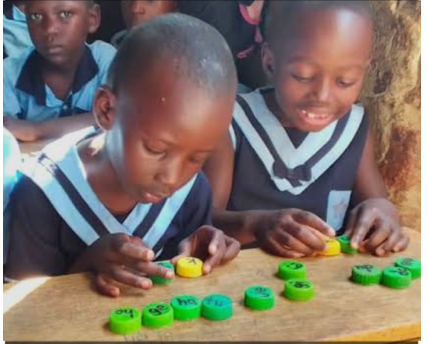
Fig.1 Students gathered around a table sorting colorful plastic bottle caps for a math counting exercise (Photo sourced from the internet).
Converting Cardboard Boxes into Classroom Organizers
Discarded shipping boxes, cereal packaging, and shoe boxes often end up as litter, yet they possess sturdy structural qualities ideal for classroom management. Students and teachers can cut, glue, and decorate these materials to create durable stationery holders, book bins, and filing shelves. This process teaches learners practical spatial design and organizational skills while maintaining a tidy, resource-efficient classroom environment without requiring institutional spending on commercial storage supplies.
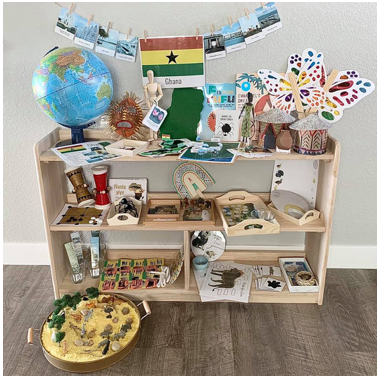
Fig. 2: A classroom shelf featuring handmade storage containers and organizers crafted from painted and decorated cardboard boxes (Photo sourced from the internet).
Converting Discarded Containers into Science Models or Storytelling Props
Plastic bottles, old tins, and fabric offcuts can be creatively repurposed to bring abstract lessons to life across multiple subjects. In science classes, students can transform plastic bottles and tubing into working water filtration prototypes or weather barometers. In language and arts classes, these same materials can be shaped into puppets and props for creative writing and cultural storytelling, encouraging learners to explore scientific principles and narrative arts using readily available local materials.
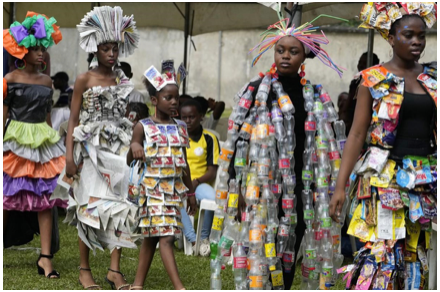
Fig. 3: Young learners showcasing African cultural attire and storytelling props made entirely from upcycled household waste (Photo sourced from the internet).
Key takeaways: Creative Initiatives to Environmental Sustainability in African Schools
Beyond material savings, these hands-on projects instill a lifelong mindset of resource conservation and circular thinking among students. By participating in school-based enterprise programs and innovation clubs, learners discover how environmental stewardship directly translates into economic value. These initiatives advance global development frameworks such as SDG 12 on Responsible Consumption and Production and SDG 13 on Climate Action, proving that schools can serve as active incubation hubs for a green economy.
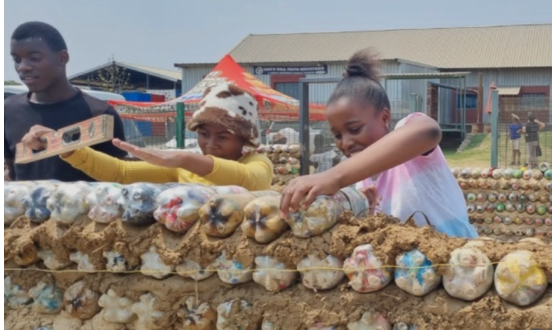
Fig. 4: Student-led upcycled crafts, eco-bricks, and recycled art installations displayed at a school environmental exhibition (Photo sourced from the internet).
This approach aligns closely with Sustainable Development Goal (SDG) 4 (Quality Education), SDG 12 (Responsible Consumption and Production), and SDG 13 (Climate Action), demonstrating how education and environmental sustainability can reinforce one another.
Overcoming Barriers to Scale
Despite these clear advantages, expanding school-based creative recycling faces structural challenges. Many teachers lack formal training in sustainability education, few schools possess organized waste segregation systems, and popular misconceptions sometimes equate recycled tools with low-quality education. Addressing these barriers requires coordinated action:
• Educational ministries and civil society groups must integrate practical waste management and upcycling into teacher training programs and national curricula.
• School administrators and local businesses should establish basic infrastructure for sorting paper, plastics, and organic waste while forming public-private partnerships.
Conclusion
Environmental sustainability begins in the classroom. Educational leaders, school headmasters, and local policymakers must actively encourage rather than overlook these creative initiatives, providing the institutional backing required to scale them. By embedding creative recycling into school culture, African education systems can raise a generation of eco-entrepreneurs and community leaders who view waste not as an environmental burden, but as a vital opportunity for innovation, economic resilience, and long-term climate adaptation.